Showing posts with label 2018. Show all posts

November 24, 2018

Solemnity of Christ the King - B (November 25, 2018)


Christ’s Kingdom Does Not Belong to this World

The author of the Book of Revelation professes that Jesus Christ “has made us into a kingdom, priests for his God and Father.”  Jesus did that when he came to live in the world, then died and rose from the dead.

That kingdom is present in this world, but that “kingdom does not belong to this world” (Gospel).

In this time of the year, we can get caught up in shopping, in buying and selling.  We live in the world where people fight over influence, compete for popularity and fame, where jealousy, hatred, violence, and war have not been banished. 

Where are our priorities?  Am I building a kingdom in this world or Christ’s kingdom, which does not belong to this world?

 Image source:  Statue of Christ the Redeemer, Basilica of St. Peter's, Vatican

November 10, 2018

32nd Sunday - B (November 11, 2018)


The Offering of Life

The poor widow “has contributed all she had, her whole livelihood.”

The word for “livelihood” can also be translated as “life.”
Besides, logically speaking, since she has contributed all she has to live on she has offered to God her very life.

Last week, Jesus taught the commandment of loving God with one’s whole heart, soul, mind, and strength. 

This week, Jesus gives us the example of this woman who offers God her life.

And by this time, Jesus is already in Jerusalem.  Soon, he will sacrifice his very life as the gift of love to God and to all humanity. 

When we receive the Eucharist, we receive this gift of Jesus’ life.  And He empowers us to love as he does.  

Image source:  www.agnusday.org
-->

November 3, 2018

31st Sunday - B (November 4, 2018)


“You are not far from the kingdom of God”

The scribe acknowledges Jesus’ teaching of the greatest commandment – love God and love your neighbor.  And Jesus tells him, “You are not far from the kingdom of God.”

Jesus came to inaugurated the kingdom of God.  The kingdom of God is not just about the future or the afterlife.  It will reach its fullness then.  But it is already here among us. 

The more we love, the more we live and spread that kingdom. 
Image source:  www.agnusday.org

October 26, 2018

30th Sunday - B (October 28, 2018)


“Have Pity on Me”

Two weeks ago, in Mark 10: 17-30, the man who “had many possessions” addressed Jesus only as “good teacher,” and asked him “What must I do to inherit eternal life?”

Last week, in Mark 10: 35-45, James and John also considered Jesus “teacher” and said to him, “We want you to do for us whatever we ask of you.”

In today’s Gospel, the blind beggar Bartimaeus recognizes Jesus as “Jesus, Son of David” and “Master.”  He keeps calling out to Jesus, “Have pity on me.”

The blind man sees.  He gets it.  He knows who he is.  More significantly, he knows who Jesus is.  

Image source:  www.agnusday.org

October 20, 2018

29th Sunday - B (October 21, 2018)


Ransom and True Freedom

Last week, a person let his possessions keep him from following Jesus.  It’s the temptation of having things in our control.

This week, the Gospel warns us of the danger of the desire for power and positions.  It’s the temptation of controlling people.

Meanwhile, Jesus surrendered even the control of his life.  He “gave his life as a ransom” to give us true freedom.   

Image source:  www.agnusday.org

October 13, 2018

28th Sunday - B (October 14, 2018)


Impossible

We continue with Chapter 10 of Mark’s Gospel.

Last week, Jesus taught his followers to have the attitude of a child – that of dependence on God.

Today, we hear of an attitude that is contrary to dependence on God.  The man has many possessions.  Consequently, he is used to be in control.  That’s why he asked Jesus, “What must I do?”  It’s hard for him to surrender that control and depend on God.  For him, that is impossible. 

What in my life makes me think that I am in charge, and makes it impossible for me to depend on God? 

Image source:  www.agnusday.org

October 7, 2018

27th Sunday - B (October 7, 2018)


Gratitude

Jesus tells us to “accept the kingdom of God like a child.” 

Children depends on their parents for everything.  So do we on God. 

As we get older, naturally, we can, and we need to do more things for ourselves.  But we then run the risk of thinking that we are in charge, and that we do not need God.

Everything comes from God, beginning with our very existence.

 
Image source:  Charles Lock Eastlake - Christ Blessing Little Children, 1839,
commons.wikimedia.org
 

September 29, 2018

26th Sunday - B (September 30, 2018)


Small

The word small is one of the themes of today’s Gospel. 

Be small.   Thinking of themselves as important, the disciples tried to stop a person who was driving out demons.  The man did so in Jesus’ name, but the disciples said, “he does not follow us.”

Care for the little ones, Jesus tells us.

And even a cup of water is enough.  Small things.

St. Therese, the Little Flower, whose feast day is tomorrow lived the spirit of Jesus’ Gospel well.  She did small things with great love. 

 Image source:  Diocese of Westminster Youth Ministry, http://dowym.com
-->

September 15, 2018

24th Sunday - B (September 16, 2018)


“Who do You Say that I Am?”

When Peter, in the names of the disciples, identified Jesus as the Christ, “he warned them not to tell anyone about him.”

Yet, Jesus “spoke openly” about his suffering, rejection, death, and resurrection.

Jesus is not hiding his identity.  Nor is he afraid of people knowing about him. 

What important is the correct understanding of who Jesus is, the Jesus who accepts the cross and crucifixion out of love.  Peter and the disciples either do not have or are not ready for this understanding. 

Maybe it’s time to evaluate my own understanding of who Jesus is.  I need to ask Jesus for the wisdom to know him as he truly is, and not my misconceptions or my own projections about him.   

Image source:  www.agnusday.org 
 

September 8, 2018

23rd Sunday - B (September 9, 2016)


“He Comes to Save You”

In last week’s Gospel, Jesus was in the Jewish area.  There, he “summoned the crowd again” and taught them.

Today, this Gospel passage begins with a list of names. They are all locations in gentile territory.  Jesus goes there to bring God’s salvation.

Jesus brings God’s salvation to both Jews and gentiles, as Isaiah had prophesized (today’s First Reading).  Salvation is God’s plan for humanity.  Salvation is always God’s initiative.  

Image source:  www.agnusday.org

September 1, 2018

22nd Sunday - B (September 2, 2018)


“Jesus Summoned the Crowd”

We humans are bodily beings.  We express our thoughts, beliefs, and emotions through perceivable attitudes, body language, facial expressions, words, actions, etc.   In fact, we communicate our very being in the same manners. 

So do we express and communicate our relationships with God and with our brothers and sisters through rituals, actions, words, emotions, etc. 

What matters, as Jesus teaches us, is that our external expressions must not for show.  They must come from our hearts. 

It might help to preserve this awareness and attitude when we remember that our existence and all we are come from God’s graciousness.  As we again see in this Gospel passage, it was Jesus who took the initiative to instruct us the way of God as “Jesus summoned the crowd” and taught them.  

Image source:  www.agnusday.org

August 25, 2018

21st Sunday - B (August 26, 2018)


“We Have Come to Believe”

“You have the words of eternal life.”  “You are the Holy One of God.”

Those are affirmative statements of faith that Peter professes.  They are even more significant considering that “many of Jesus’ disciples” now walk away from him.

Peter and the rest of the Twelve could not have just profess such faith in Jesus on the spot.  It is the result of a process.  Peter says, “We have come to believe and are convinced.”

Faith is first and foremost a gift from God.  However, Peter and his friends “have come to believe” in Jesus because they have been with him, listened to him, and shared life with him.

Only by spending time with Jesus can we come to believe and are convinced that he has the words of eternal life and that he is the Holy One of God.  

August 18, 2018

20th Sunday - B (August 19, 2018)


The Eucharist – The Gift of Eternal Life

In the Gospel of John, Jesus uses the phrase “eternal life” more than he does in all 3 other Gospels combine.  This is a major theme in John’s faith in Jesus.

In Chapter 3, Jesus speaks of eternal life as the gift of God’s love for the world in giving his only Son: “God so loved the world that he gave his only Son, so that everyone who believes in him might not perish but might have eternal life.”  (3:16).

Later, Jesus prays during the Last Supper, summarizing his mission that he spoke of in 3:16: “Now this is eternal life, that they should know you, the only true God, and the one whom you sent, Jesus Christ.”  Knowing Jesus is having eternal life.

And in today’s Gospel, Jesus speaks of his body and blood as the gift of eternal life already given to us even now.  “Whoever eats my flesh and drinks my blood has eternal life.”  (Note:  the verb is in the present tense).

Knowing Jesus is not some abstract knowledge.  In his body and blood, we encounter the Divine and God’s loving gift of eternal life.

Image source:  www.agnusday.org

August 11, 2018

19th Sunday - B (August 12, 2018)


“My Flesh for the Life of the World”
John 6:41-51

In this short passage, 10 verses in total, Jesus repeats five times the universality of God’s salvation. Though they are different, the words “whoever,” “anyone,” and “everyone” convey the same meaning. 

God’s salvation is given to all humanity in the coming, death, and resurrection of God’s only Son, Jesus Christ. 

This salvation continues to be given to us today in the Eucharist – “The bread that I will give is my flesh for the life of the world.” 


August 4, 2018

18th Sunday - B (August 5, 2018)


“Give Us This Bread Always”

People went looking for Jesus because they “ate the loaves and were filled.”  Now they want more of the same kind of bread.

That causes them to lose sight of the greater gift Jesus has for them – “the bread of life.”

What things that do not last forever, or desire and expectation of them, draw me away from the bread of life?

Image source: https://www.qumran2.net

July 28, 2018

17th Sunday - B (July 29, 2018)


Abundance

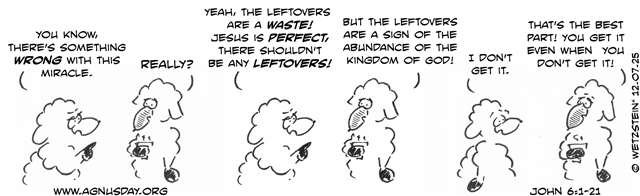
Beginning today, for five Sundays, instead of the Gospel of Mark, we’ll have Chapter 6 from the Gospel of John. Jesus speaks of himself as the Bread of Life for the most part of this chapter.

The chapter begins with this miracle.  And John certainly highlights the abundance of the food that Jesus gives.

What humans can offer is so limited.  “Two hundred days’ wages worth of food would not be enough for each of them to have a little.”  “A boy has five barley loaves and two fish; but what good are these for so many?”

In contrast, Jesus gave them “as much as they wanted.”  There was “more than they could eat.”  They “had their fill.”  And there were still twelve full baskets of leftovers.  

Image source:  www.agnusday.org

July 22, 2018

16th Sunday - B (July 22, 2018)


Jesus Christ – the Source and Model of Compassion 

Jesus gives us brothers and sisters to love and he shows us how to be compassionate. 

St. Paul, a Jew, calls the Gentile Ephesians his “brothers and sisters.”  He then gives the source of this relationship.  It is Christ who has brought all into God’s family by his blood on the cross (2nd Reading).

And Jesus himself is the ultimate model of compassion – “his heart was moved with pity” for the people when he saw them “like sheep without a shepherd.”   

Jesus' attitude should challenge me to ask if I discriminate people who are different.  Moreover, do I live the compassion of Jesus in treating other people in my life?

Image source:  www.agnusday.org
 

July 14, 2018

15th Sunday - B (July 15, 2018)


We Are God’s Children

Today’s second reading and the Gospel complement each other in giving us an exhortation in our identity and mission in the world. 

In the second reading, we hear Paul’s conviction that even before God created the world, “God chose us in Christ to be holy and without blemish.”  Moreover, “in love, God destined us for adoption to himself through Jesus Christ.”  Thus, in Christ, by God’s grace, we have become God’s children.

Then in the Gospel, Jesus “summoned the Twelve and began to send them out” with his power to do what he himself had been doing – to preach, to drive out demons, and to cure the sick. 

What was given to the Twelve continues with us today.

By God’s favor, we are children of God, sharing in the mission of God’s only Son. 

Image source:  www.agnusday.org

July 7, 2018

14th Sunday - B (July 8, 2018)


"Is He not …?"

The people from Jesus’ native place think that they know who Jesus is, but they don’t. 

How about me?

If I want to know Jesus, I first have to spend time with him.

I can also let him tell me more about him.  And one way of doing that is to read, reflect on, and pray with Scriptures.

I cannot really say I don’t have time to read the Bible. 
To put things in perspective, a news article averages 500 – 800 words.  A novel has between 50,000 to 110,000 words.  For example, Harry Potter and The Sorcerer’s Stone is about 77,500 words total.
A biography on the life of so-and-so has an average of 80,000 to 200,000 words.

Meanwhile, the Gospels are not just Jesus’ biography or some stories about him.  Jesus reveals himself to us through those words. 

And the entire Gospel According to Mark has 11,304 words, which is about 22 single-space typed pages. 

That should put things in perspective if I think I don’t have time to read the Bible and let Jesus speak to me.  


July 1, 2018

13th Sunday - B (July 1, 2018)


“Daughter”

The Gospel tells us that the adult woman “was afflicted with hemorrhages for twelve years.”  This particular illness would have made her unclean by the ritual regulations of the time.  As a result, she became an outcast from the chosen people of God [1] all those long twelve years.

After Jesus has cured her, he calls her, “daughter.”  Interestingly, in all four Gospels, this is the only person Jesus addresses directly as “daughter.” 

Jesus heals her of her physical illness.  Moreover, he restores her place in God’s family.  She is forever a daughter of God.  

----------
[1] Francis J. Moloney, The Gospel of Mark: a Commentary. Peabody, Massachusetts: Hendrickson Publishers, 2002, p. 107.

Image source:  Online, no credit was given