August 26, 2017

21st Sunday - A (August 27, 2017)

-->

Commentary

Who Do You Say that I Am?

In the first question, Jesus asks the disciples for people’s opinion about him.

In the second question, Jesus asks the disciples for their own opinion about him. 

In response, Peter, in the name of the group, professes that Jesus is “the Son of the living God.” 

This is not the first time they acknowledge Jesus as the Son of God.  The group did it once after Jesus calmed to storm (Matthew 14:33).  They were then identified as “those who were in the boat.”   

Now, Peter is the first person identified by name to profess this faith in Jesus.  [1] 

It is not enough knowing what people say about Jesus.  It is not enough to know the faith of a group, even though it is essential to share the faith of the Church community.  After all, each of us has received the gift of faith and its knowledge through the Church. 

Yet, faith must be both communal and personal.  It must be both my faith and our faith.

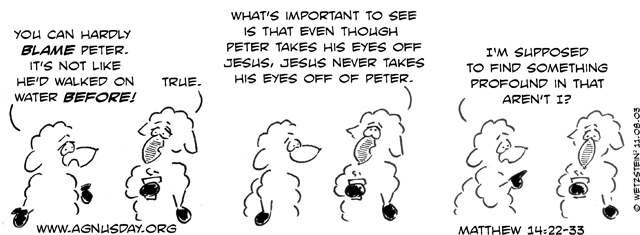
Image source:  www.agnusday.org  

[1]  John Petty.  www.progressiveinvolvement.com

August 19, 2017

20th Sunday - A (August 20, 2017)

-->

Commentary
“Lord, Help Me”

While reading this passage, we are often shocked at Jesus’ seemingly insulting words to the woman.

Why could the woman not feel offended?

There are at least two details in this passage that can help us to understand her attitude.  More importantly, we might better appreaciate the source of her courage.

First, Matthew tells just that Jesus himself goes to the region of Tyre and Sidon (top left corner on the map).  This is the region of the gentiles.  And the woman herself is from that area. 

Second, Jesus speaks to the woman.

We have here a devout Jew, one the woman recognizes as the Promised Savior of the Jews and Lord, going to the region of the gentile of his own. 

Moreover, he speaks to her.  This would have rendered him unclean. 

Other Jewish religious leaders would not have done that.

Jesus takes the initiative to reach out to the religious and ethnic outcasts of his time.  In fact, he reaches out to people who for generations have been the Jews’ enemies.

This passage, therefore, is really about Jesus’ reaching out to the gentiles and outcasts.  Jesus’ attitude gives the woman the courage to approach and appeal to him.


August 12, 2017

19th Sunday - A (August 13, 2017)


Reflections

“I Am”

Prior to this passage, the disciples could not feed the crowd of over five thousand people.  Jesus could.

Now, the disciples are in the boat by themselves, “being tossed about by the waves.”  Jesus came, and “the wind died down.”

Jesus here identifies himself, “It is I.”  What Jesus says in the Greek text can be translated into English as “I am.”  It is the same expression God used at the burning bush when Moses asked for God’s name in Exodus 3:14.

In the Incarnation, Jesus, who is divine, is always with us. 

I should not cry out for Him only when things are tough, when I am in need, or when I am “being tossed about by the waves” of life.  

 Image source:  www.agnusday.org

August 5, 2017

Feast of Transfiguration of the Lord - A (August 6, 2017)


Commentary


Beloved Child of God

When I take a selfie, or when I look into a mirror, what do I see?
Do I see myself as a child of God?

And what do people say when they are with me?

You may want to spend some time repeating and meditating on one of these two sentences from today’s Gospel. 

The first sentence, as you meditate with it, imagine that God is speaking to you and about you.  “This is my beloved son/daughter, with whom I am well pleased.”

The second sentence, as you meditate with it, imagine that people who meet you or spend time with you are saying, “It is good that we are here.”  They say that because they are with you, a child of God, just as Peter did when he was with Jesus. 

 (Image source:  www.freepik.com) 
 

July 29, 2017

17th Sunday - A (July 30, 2017)


The Image of Jesus Christ

In politics, people often split camps by what they consider conservative and liberal values. 

In recent years, so much talk and ink (and keystrokes) seem to have deepen the chasm between the traditional and progressive camps also in religions, including Christianity.

Jesus’ words today urge us to learn to appreciate and make use of “both the new and the old.”

We trust in the promised the Risen Christ made, “I am with you always, until the end of the age” (Matthew 28:20).  We believe that the Holy Spirit, the gift from the Father, constantly guides the Church.  Therefore, the Church is always renewed.  At the same time, She constantly draws from Her rich storeroom.  That is why we say the Church is always alive. 

At the same time, the Holy Spirit guides each of us toward the goal of the Christian life.  This goal is not about being traditional or progressive, conservative or liberal. 
We are called to become more and more “conformed to the image of Christ.” (Second Reading).

May we have the courage of Solomon to pray for the wisdom to discern and to become more like Jesus Christ (First Reading).

Image source:  http://bfcnaz.com

July 22, 2017

16th Sunday - A (July 23, 2017)


Commentary

Small Seeds of Goodness

Throughout human history, people have made (and continue to make) various attempts to explain the confounding question of good and evil.  It takes place in philosophy, ethics, literature, theology, arts, … and over a cup of coffee or a glass of beer.

In today’s first parable, Jesus tells us that good and evil will always coexist.  At times, it is not easy to separate them.  In fact, we know well that both good and evil exist in each one of us.

We will always have to live with this confusing dichotomy. 

One thing is clear, however.  Both good and evil can begin with a tiny seed. 

While in this life, we cannot always totally uproot evil.  However, we can plant the seeds of goodness.  And as Jesus tells us in the first parable, the weed cannot choke out the wheat.  It still bears good fruit. [1] 

Small seeds, with God’s grace, will become “the largest of plants.”  


---------------
[1] www.progressiveinvolvement.com
Image source:  www.agnusday.org 

July 15, 2017

15th Sunday - A (July 16, 2017)


Commentary


A Path, Rocky Ground, Thorny Ground, or Rich Soil

This parable has three elements: the sower, the seed, and the ground.

The sower is the focus of the parable.  In fact, Jesus entitles it “the parable of the sower.” [1]  The outstanding and ever peculiar quality of the sower is that he sows generously and indiscriminately of the kinds of ground.  This is not typical behavior of farmers.  What does Jesus tell us here about the way God sows the seed of God’s word?

The seed is small, and may appear insignificant [2].  Yet, the genetic code for a plant or a large shrub is all there in that small seed.  The seed of God’s word has all the potential “to bear fruit and yields a hundred or sixty or thirtyfold.” 

Then there is the ground.  That’s me!

God sows the seed of God’s word generously.  The seed has all that is needed to bear fruit.

What kind of soil my ground is for the seed is up to me.  


-----------------
[1] & [2]  http://www.progressiveinvolvement.com
Image source:  www.agnusday.org